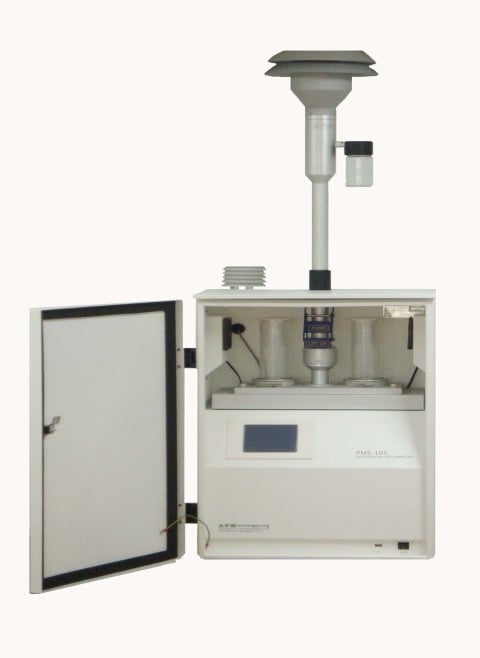
PM2.5
Theory
PM refers to fine particles that are 2.5 micrometers (μm) or smaller in diameter. 2.5 Ambient air is defined as any unconfined part of the Earth's atmosphere, that is, the surrounding outdoor air in which humans and other organisms live and breathe.
Principle
An electrically powered air sampler draws ambient air at a constant volumetric flow rate (16.7 lpm) maintained by a mass flow or volumetric flow controller coupled to a microprocessor into a specially designed inertial particle-size separator (i.e., cyclones or impactors) where the suspended particulate matter in the PM size ranges is separated 2.5 for collection on a 47 mm polytetrafluoroethylene (PTFE) filter over a specified sampling period. Each filter is weighed before and after sample collection to determine the net gain due to the particulate matter. The mass concentration in the ambient air is computed as the total mass of collected particles in the PM size ranges divided by the 2.5 actual volumes of air sampled, and is expressed in μg/m3. The microprocessor reads averages and stores five-minute averages of ambient temperature, ambient pressure, filter temperature, and volumetric flow rate. In addition, the microprocessor calculates the average temperatures and pressures, the total volumetric flow for the entire sample run time, and the coefficient of variation of the flow rate.
Sitting Requirements
Samplers should be sited to meet the goals of the specific monitoring project. For routine sampling to determine compliance with the National Ambient Air Quality Standards (NAAQS), sampler sitting, as described in CPCB guidelines, should be done outside the zone of influence of sources located within the designated zone of representation for the monitoring site. The height of the inlet must be 3–10 m above ground level. And at a suitable distance from any direct pollution source, including traffic. Large nearby buildings and trees extending above the height of the monitor may present barriers or deposition surfaces for PM. The distance of the sampler to any air flow obstacle, i.e., buildings, must be more than two times the height of the obstacle above the sampler. There should be unrestricted airflow in three of the four quadrants. Certain trees may also be sources of PM in the form of detritus, pollen, or insect parts. These can be avoided by locating samplers and placing them > 20 m from nearby trees. If collocated sampling has to be performed the minimum distance between two Samplers should be 2 m.
Apparatus and Materials
a) Electronic microbalance with a minimum resolution of 0.001 mg and a precision
of ± 0.001 mg, supplied with a balance pan. The microbalance must be
positioned on a vibration-damping balance support table.
b) Calibration weights, utilized as mass reference standards should be non-corroding, range in weight from 100 mg to 200 mg, and be certified as traceable to NIST mass standards. The weights should be ASTM Class 1 category with a tolerance of 0.025 mg.
c) Non-serrated forceps for handling filters.
d) Non-metallic, non-serrated forceps for handling weights.
e) Digital timer/stopwatch.
f) 47 mm Filter: Teflon membrane, 46.2 mm effective diameter, with a polypropylene support ring or filters as recommended by FRM / FEM sampler manufacturer.
g) Filter support cassettes and covers.
h) Plastic petri-slide filter containers (filter cassette).
i) Zip-lock plastic bags, 6" 9".
j) Disposable laboratory wipes.
k) Filter equilibration cabinets.
l) Impactor oil/grease
Analysis
Filter inspection: Inspect the filter for pinholes using a light table. Loose particles should be removed with a soft brush. Apply the filter identification number or a code to the filter if it is not numbered. Condition the filter in a conditioning room maintained at 20–30 °C and 40–50% relative humidity or in an airtight desiccator for 24 hours. Take the initial weight of the filter paper (Mi) before sampling. Condition the filter after sampling in a conditioning room maintained at 20–30 °C and 40–50% relative humidity or in an airtight desiccator for 24 hours. Take final weight of the filter paper (Mf)
Calculation and Reporting of Mass Concentrations
Volume of air sampled = Sample flow rate x sampling time
For Example:
Flow rate = 16.7 l/min
Sampling time = 8 hours = 8 x 60 = 480 minutes
Volume of air = 16.7 (l/min) x 480 (minutes) = 8016 liter
The equation to calculate the mass of fine particulate matter collected on a Teflon
The filter is as below:
M = (Mf - Mi) x 109 /V μg
Where,
M = total mass of fine particulate collected during sampling period (μg)
Mf = final mass of the conditioned filter after sample collection (g)
Mi = initial mass of the conditioned filter before sample collection (g)
109 = unit conversion factor for milligrams (g) to micrograms (μg) & liter to m3
V = Volume of air sampled, lpm