PM10
Study of particulate matter (PM10) in ambient air.
PM10
Principle
Principle of the method Air is drawn through a size-selective inlet and through a 20.3 X 25.4 cm (8 X 10 in) filter at a flow rate, which is typically 1.1 m3/min. Particles with an aerodynamic diameter less than the cut-point of the inlet are collected, by the filter. The mass of these particles is determined by the difference in filter weights prior to and after sampling. The concentration of PM in the designated size range is calculated by dividing the weight 10 gain of the filter by the volume of air sampled.
Instrument/Equipment
The following items are necessary to perform the monitoring and analysis of Particulate Matter PM10 in ambient air:
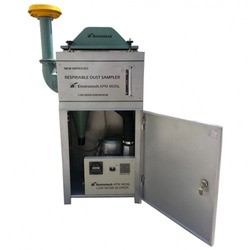
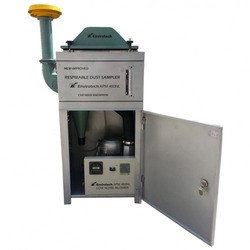
Analytical balance, High Volume Sampler with a size-selective inlet for PM10 with automatic volumetric flow control, Calibrated flow-measuring device to control the airflow at 1.1 m3/min. Reagents / Chemicals Filter Media
A Glass fiber filter (EPM 2000) of 20.3 X 25.4 cm (8 X 10 in) size.
Theory
Air sampling is capturing the contaminant from a known volume of air, measuring the amount of contaminant captured, and expressing it as a concentration. The air is passed through a filter medium (normally a paper for solid contaminants and a sorbent for gases). The volume of air is measured against the amount of contaminant captured. This gives the concentration, which is expressed either as milligrams per cubic meter (mg/m3) or parts per million (ppm). The volume of air is calculated by multiplying the flow rate through the filter medium by the time in minutes. Calibration of the flow rate is important and should be carried out before and after each sample is taken.
Sampling
Field Sampling - Tilt back the inlet and secure it according to the manufacturer's instructions. Loosen the faceplate wing nuts and remove the faceplate. Remove the filter from its jacket and center it on the support screen with the rough side of the filter facing upwards. Replace the faceplate and tighten the wing nuts to secure the rubber gasket against the filter edge. Gently lower the inlet. For automatically flow-controlled units, record the designated flow rate on the datasheet. Record the reading of the elapsed time meter. The specified length of sampling is commonly 8 hours or 24 hours. During this period, several readings (hourly) of the flow rate should be taken. After the required time of sampling, record the flow meter reading, take out the filter media from the sampler, and put it in a container or envelope.
Analysis
Filter inspection: Inspect the filter for pinholes using a light table. Loose particles should be removed with a soft brush. Apply the filter identification number or a code to the filter if it is not numbered. Condition the filter in the conditioning room maintained within 20-30°C and 40-50% relative humidity or in an airtight desiccator for 24 hours. Take the initial weight of the filter paper (Wi) before sampling. Condition the filter after sampling in the conditioning room maintained within 20-30°C and 40-50% relative humidity or in an airtight desiccator for 24 hours. Take the final weight of the filter paper (Wf)
Calculation of the volume of air sampled:
Volume of air sampled = Sample flow rate x sampling time
For Example:
Flow rate = 1.1 m3/min
Sampling time = 8 hours = 8 x 60 = 480 minutes
Volume of air = 1.1 (m3/min) x 480 (minutes) = 528 m3
C PM μg/m3 = (Wf - Wi) x 106 / V
Where,
C PM = Concentration of PM, μg/m3
Wf = Final weight of filter in g
Wi = Initial weight of filter in g
106 = Conversion of g to μg
V = Volume of air sampled, m3